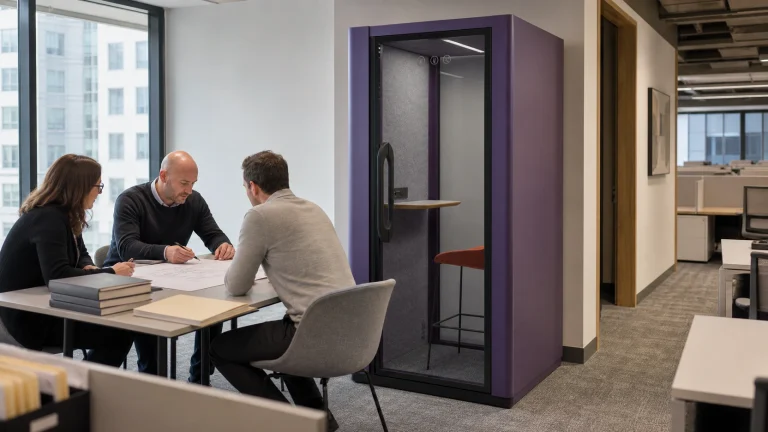
A soundproof phone booth is best treated as a product category, not an absolute promise. The useful buyer question is not “Is it soundproof?” It is “What acoustic quantity was measured, on which exact model, under which method and conditions?”
A dated report can answer part of that question. A number without its metric, test method, tested configuration, frequency range, limitations, and report owner cannot. It may describe a different product, a component rather than the complete enclosure, or a laboratory condition that has not been connected to the installed project.
This guide gives procurement and workplace teams a defensible way to mark each claim as comparable, qualified, rejected, or pending.
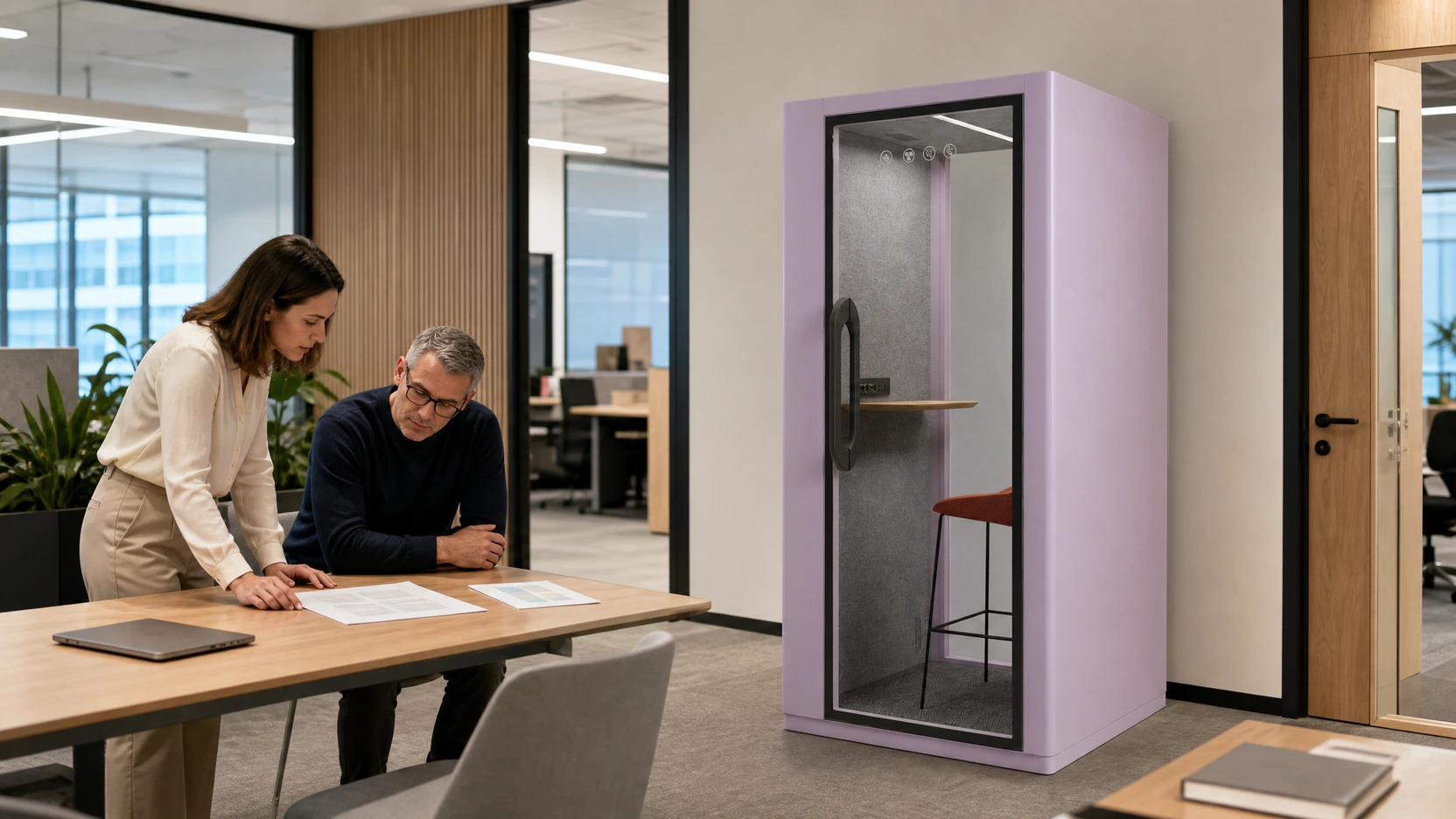
Start with the claim, not the label
“Soundproof” can mean several different things in a sales conversation. One person may mean that speech is less distracting outside the booth. Another may mean that words should be difficult to understand. A third may expect speech to be entirely inaudible or confidential.
Those are not interchangeable requirements.
Write the intended outcome before comparing products. Keep it observable and project-specific:
- reduce the distraction created by ordinary calls near workstations;
- create a more suitable place for video meetings than an open desk;
- improve speech privacy for a defined conversation type;
- keep a named activity within an agreed workplace acoustic brief;
- provide a report-backed enclosure result for procurement comparison.
Do not turn zero audible speech into a default target. Do not treat acoustic performance as a guarantee that a conversation is confidential. If legal, regulatory, security, or clinical privacy matters, route that requirement to the responsible project specialist.
The broader office-pod selection guide helps when the activity, capacity, or product category is still undecided.
Know what ISO 23351-1 measures
The official ISO 23351-1:2020 page describes a laboratory method for comparing complete furniture ensembles and enclosures. It measures sound power in two situations: first with the product absent, then with the sound source inside the product in the occupant position.
The difference is measured across 1/1-octave frequency bands from 125 Hz to 8000 Hz. The standard also defines a single-number A-weighted speech-level-reduction quantity across that range.
That scope matters. It gives a buyer a named method for a complete enclosure, not a loose adjective.
It also defines a boundary. ISO says the method is not intended for isolated workstation components such as a screen, table, chair, cupboard, wall absorber, or ceiling absorber. A material datasheet and a complete-booth report answer different questions.
What a laboratory result does not decide
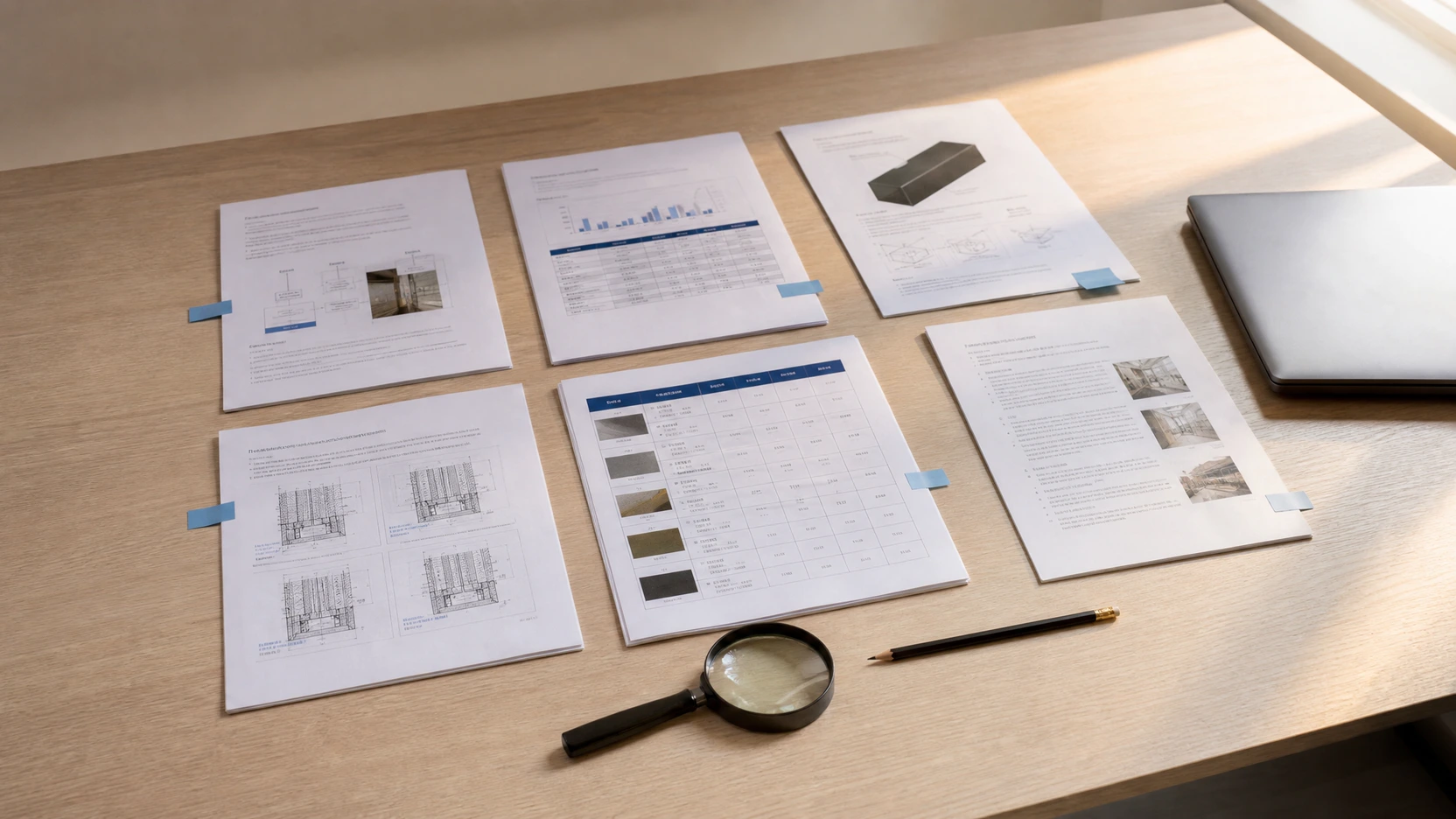
A laboratory result does not, by itself, document how an installed booth performs in every room. It does not confirm that the report applies to a different size, revised door, changed glazing, new ventilation setup, alternative wall build-up, or another assembly condition.
It also does not replace the workplace brief. The project team still needs to define the activity, surrounding noise, distance to nearby users, room finishes, placement, operating conditions, and acceptable outcome.
Use the laboratory report as one controlled input. Keep site performance, user experience, and any compliance decision as separate review layers.
Separate the acoustic terms buyers confuse
Acoustic documents often place several familiar abbreviations beside the word “dB.” The shared unit does not make the metrics equivalent.
| Term or wording | What it is useful for | Why it cannot be substituted automatically |
|---|---|---|
| Speech-level reduction under ISO 23351-1 | Comparing complete furniture ensembles or enclosures under the named laboratory method | It is tied to the complete tested enclosure, method, frequency range, and configuration |
| Rw under ISO 717-1 | Rating airborne sound insulation of buildings and building elements such as walls, floors, doors, and windows | The scope and rating route differ from the complete-enclosure speech method |
| STC under ASTM E413 with the relevant test method | Classifying sound insulation for the applicable transmission measurement | It is not a synonym for every enclosure dB figure |
| NRC or absorption coefficient under ASTM C423 | Describing sound absorption measured by the reverberation-room method | Absorption inside a space is not the same quantity as speech reduction through a complete enclosure |
| Percentage sound insulation | Only useful when a defined method explains the calculation and scope | A percentage cannot be inferred from an unrelated dB figure |
| “Soundproof” | Search and category language | It does not identify a metric, method, result, configuration, or limit |
The official ISO 717-1 page, ASTM E413 page, and ASTM C423 page provide the relevant scope descriptions.
When two suppliers use different metrics, record them in separate columns. Do not rank them as though they were the same test.
Test the claim against real use scenarios
Start with three or four scenarios that matter to the project. The goal is not to create a universal acoustic score. It is to see whether the available evidence answers the decision you actually have.
Ordinary calls near open workstations
Record typical call behavior, surrounding activity, spacing, and the team’s practical acceptance criteria. Ask whether the supplied evidence covers speech-level reduction for the complete enclosure and whether the tested configuration is the configuration being quoted.
Video meetings with amplified voices
Note speaking level, headset or speaker use, equipment, expected duration, and booth placement. A product report may help compare enclosures, but the project still needs a realistic workplace check.
Sensitive conversations
Separate reduced speech transmission from confidentiality. Identify who owns the privacy requirement, which conversations are in scope, and what additional controls are needed. Do not let a product label make that decision.
Focus work without speaking
Speech-level-reduction evidence may not be the main criterion. Interior sound, ventilation operation, surrounding noise, visual privacy, furniture, lighting, access, and expected stay may matter more.

The office pod sizes guide can support the separate capacity and fit review. Keep that work apart from the acoustic claim so one missing field does not disappear inside another.
Build a report-first evidence pack
Ask for the complete report, not a cropped chart or one number copied into a catalogue.
Use the same fields for every product under review:
| Evidence field | What to record | Stop condition |
|---|---|---|
| Metric | Exact name, symbol, unit, and meaning | “dB” appears without a named quantity |
| Method | Standard number, edition, part, and laboratory or field route | Method is absent or refers only to a component |
| Report control | Issuer, report number, date, revision, page count, and signature or approval | Only a marketing summary is supplied |
| Sample identity | Exact model, size, serial/sample ID, and product-family mapping | Model wording is broad or ambiguous |
| Configuration | Door, glazing, wall build-up, ventilation state, seals, furniture, and deviations | Quoted configuration cannot be matched |
| Test boundary | Room, source and microphone positions, environmental condition, background condition, and operating state | Setup is too incomplete to interpret |
| Results | Frequency-dependent data, single-number result, classification if applicable, and uncertainty | One headline value has no supporting table |
| Limitations | Sample-only language, subcontracting, exclusions, usage permission, and other stated restrictions | Restriction conflicts with intended public use |
| Current applicability | Product-owner confirmation that the report matches the sale configuration | A legacy or revised configuration is being assumed |
A supplier can record “not stated” or “N/A.” That is better than filling the gap with a guess. The important move is to keep the gap visible when the bid or specification is reviewed.
Assign an owner to every evidence layer
A complete report can still be misused when nobody owns the link between the tested sample and the product being purchased.
Separate the responsibilities before the comparison is approved:
| Evidence layer | Typical owner | Required action |
|---|---|---|
| Test document | Laboratory or report issuer | Confirm report control, method, result, uncertainty, limitations, and status |
| Product mapping | Supplier and product owner | Match the exact tested sample to the current sale configuration and record every deviation |
| Claim wording | Product owner and editorial reviewer | Approve, qualify, or reject the wording that will appear in a tender, catalogue, or website |
| Project acoustic brief | Acoustic consultant or responsible project lead | Define the intended outcome, room context, acceptance route, and any field review |
| Workplace scenario | Workplace and facilities team | Record activities, surrounding conditions, users, operating assumptions, and exceptions |
| Procurement record | Procurement lead | Preserve the evidence, decision label, owner, date, and unresolved fields with the commercial comparison |
One person may hold more than one role on a smaller project. The responsibilities should still remain visible. A supplier cannot silently turn a laboratory result into project acceptance, and a project team should not rewrite an absent test field from memory.
This ownership map also clarifies the next request. If the method is missing, go to the report issuer. If the size or configuration does not match, go to the product owner. If the report is clear but the project outcome is not, ask the acoustic or project lead to define the acceptance route.
Compare only like with like
A useful comparison holds the evidence route steady.
If Product A reports speech-level reduction under ISO 23351-1 and Product B supplies an absorption coefficient for an interior panel, the two numbers do not form a ranking. Ask Product B for the comparable enclosure report, or record the comparison as pending.
Use the same sequence for every supplier:
- match the metric and method before comparing any number;
- match the tested model, size, and configuration to the product being quoted;
- review report control, limitations, uncertainty, and public-use status;
- assign a comparable, qualified, rejected, or pending label and record the owner of every open field.
Apply the same rule to configurations. A result for one size does not automatically transfer to a larger model. A result for one door or ventilation condition does not silently approve another. A revised product needs a controlled mapping, not a similar photograph.
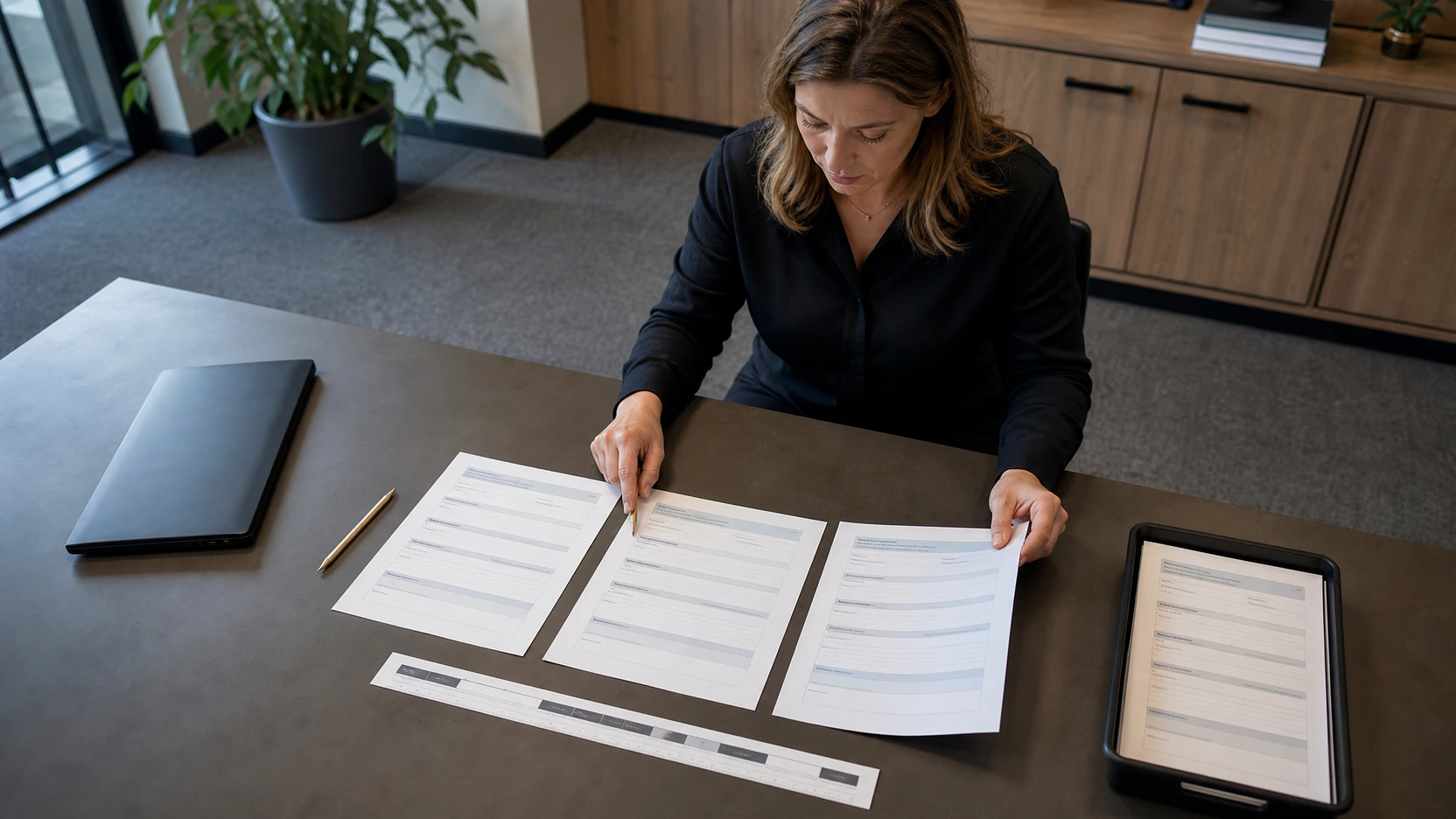
Use four decision labels:
- Comparable: same relevant metric and method, with tested configurations and report controls clear enough for the intended comparison.
- Qualified: evidence exists, but the wording must name its scope, configuration, or limitation.
- Rejected: the claim uses an unsupported conversion, absolute promise, missing method, or mismatched evidence.
- Pending: the evidence may exist, but a required report, field, mapping, or approval is missing.
These labels prevent a polished brochure from receiving more evidential weight than a controlled report.
Record unknowns before asking for a quote
An acoustic comparison should end with a short exception register. This turns uncertainty into a project action.
| Open field | Current status | Owner | Required next evidence |
|---|---|---|---|
| Exact sale configuration matches tested sample | N/A or pending | Product owner | Controlled model/configuration mapping |
| Test method and edition | N/A or confirmed | Supplier or laboratory | Complete report |
| Door and ventilation condition | N/A or confirmed | Supplier or laboratory | Report detail or controlled addendum |
| Measurement uncertainty | N/A or confirmed | Laboratory | Report statement |
| Public-use permission | N/A or confirmed | Report owner | Written permission or public report version |
| Project acoustic acceptance | Pending | Acoustic consultant or project lead | Project-specific criteria and review |
Do not delete the N/A rows after a supplier replies to easier questions. Those rows show why a claim remains qualified or why a comparison cannot yet be made.
For a wider commercial review, the office pods for sale guide covers scope items that sit beside acoustics, including intended activity and supplier evidence.
Use a decision record, not a soundproof score
The final output can fit on one page.
Record the intended activity, target claim, exact metric, method, report control, tested configuration, quoted configuration, limitations, public-use status, project reviewer, and decision label. Add the date and owner for every pending item.
This is more useful than inventing one composite soundproof score. It shows what has been verified, what has been compared, and what still needs a named person to decide.

For MOVUSH product selection, treat current model-specific acoustic values as pending until the applicable report and configuration mapping are approved for the exact product being quoted. The public MOVUSH acoustic pods overview can introduce the category, but the controlled report must carry any technical performance comparison.
Set the boundary before selection
A soundproof phone booth claim becomes useful only when the evidence chain is visible. Name the metric. Name the method. Match the exact tested model and configuration. Read the limitations. Compare only documents that answer the same question.
If any link in that chain is missing, qualify, reject, or hold the claim as pending. Do not fill the gap with a percentage, a different acoustic rating, or an assumption that one model represents another.
Request the current technical sheet and applicable acoustic report for the exact model and configuration being compared. MOVUSH can then identify the fields that are confirmed, the fields that remain N/A, and the project reviews still required before selection.