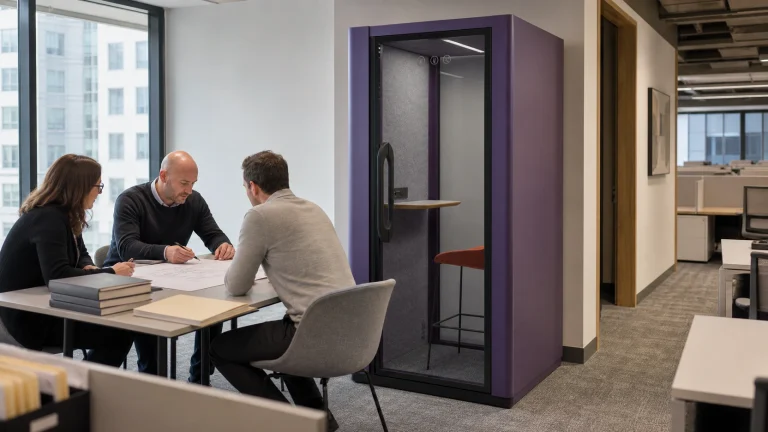
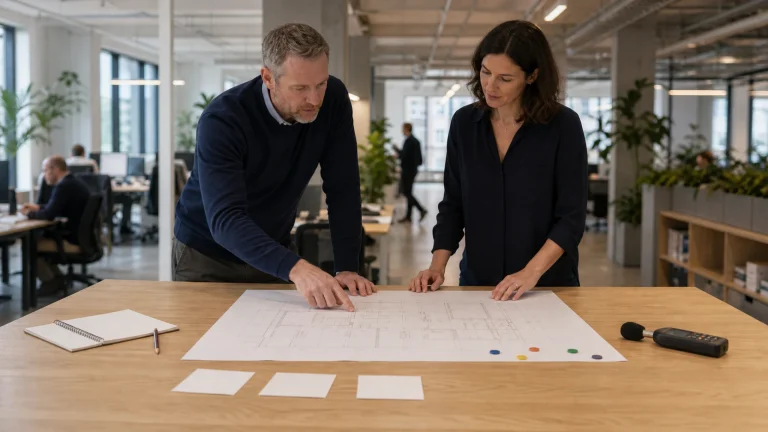
Office pod speech privacy is not decided by one dB figure. It is decided at the listener: can a person in a position that matters understand enough of the conversation to create a workplace, personal, legal, or security problem?
A complete-enclosure test can show how much a pod reduces radiated speech level under a named method. It cannot, by itself, approve every listener position in every office. Intelligibility also changes with the talker, distance, room surfaces, background sound, placement, door use, ventilation state, and the receiving person’s attention.
Start by defining the conversation risk. Then select evidence and a site acceptance route that answer that exact requirement.
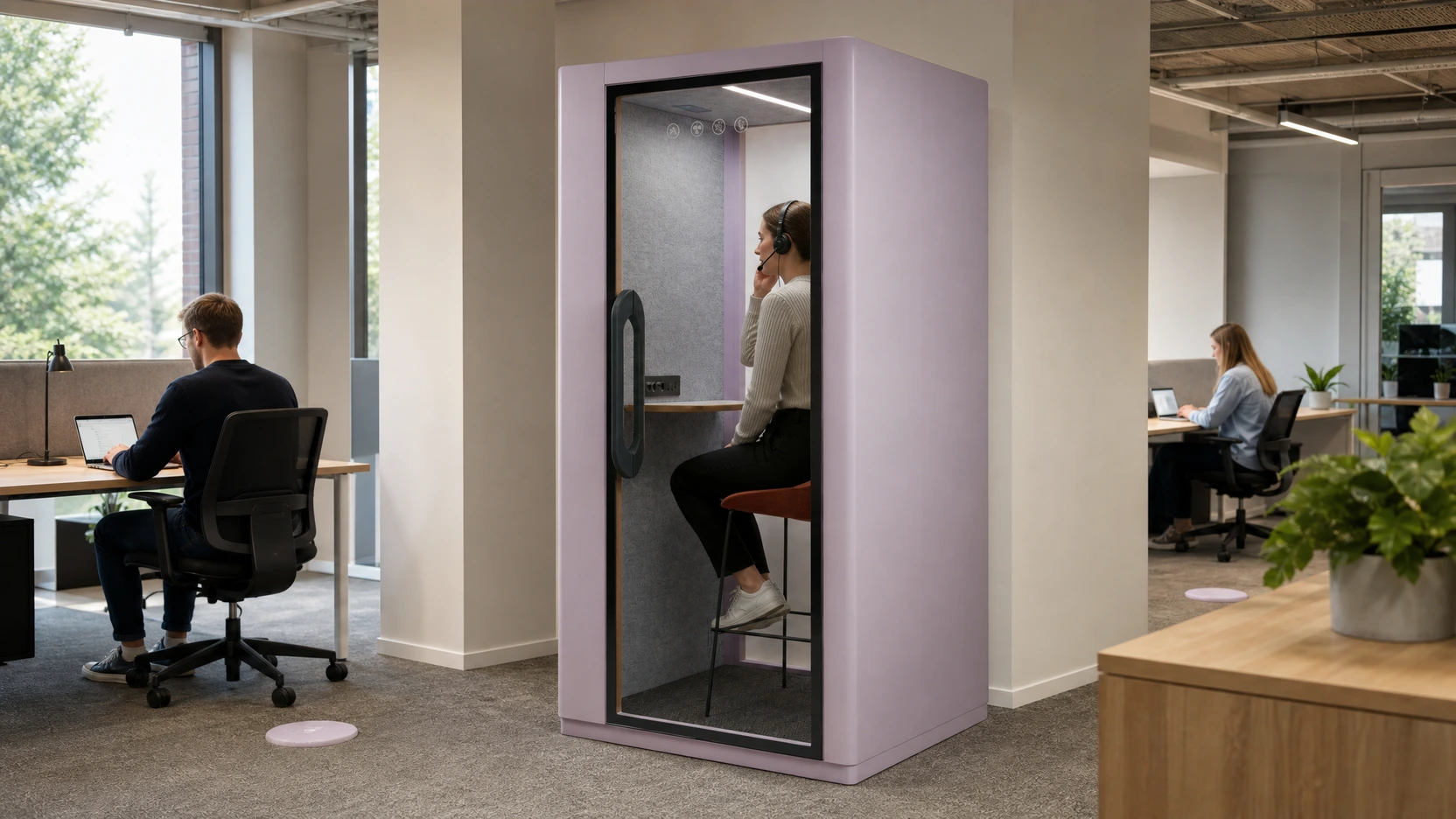
Define the conversation risk first
“Private” means different things to different stakeholders. A workplace team may want ordinary calls to stop distracting nearby desks. HR may need personal information to be harder for passers-by to understand. Legal or security teams may have a defined threat, policy, or jurisdictional requirement.
Do not compress those needs into “soundproof.”
Use a short conversation-risk brief before comparing products:
| Brief field | What to record |
|---|---|
| Conversation type | Routine call, client discussion, employment matter, legal discussion, clinical topic, or security-sensitive exchange |
| Talker behavior | Typical voice, raised voice, speakerphone, video meeting, headset, or more than one speaker |
| Protected listener positions | Adjacent desk, circulation route, reception, waiting area, meeting setting, or another floor-plan point |
| Consequence | Distraction, awkward overhearing, personal-data exposure, contractual risk, safety risk, or another named concern |
| Operating condition | Door closed, ventilation running, expected equipment in use, and normal surrounding activity |
| Decision owner | Workplace, facilities, acoustic consultant, HR, legal, security, client, or another responsible role |
| Acceptance route | Document review, representative pilot, specialist measurement, witnessed sign-off, or escalation |
ISO 22955:2021 treats open-office acoustics as an activity-led project involving end users, project owners, designers, acousticians, contractors, and occupational specialists. That is a useful boundary: the activity and accountable stakeholders come before the product claim.
Separate speech level from intelligibility
Loudness and intelligibility are related, but they are not the same decision.
A listener might hear that somebody is speaking without understanding the words. In another setting, a relatively quiet voice may remain intelligible because the room is calm, the listener is close, and there is little competing sound. Speech privacy therefore concerns the information available to the listener, not merely the presence of audible sound.
The IEC 60268-16:2020 page defines the Speech Transmission Index (STI) model and measurement or prediction methods for objectively rating speech intelligibility. IEC also notes that every method has limitations, including when speech privacy is the application.
That does not create a universal STI target for pods. A competent reviewer must define the method, speech level, background condition, listener positions, equipment, and acceptance criteria for the project.
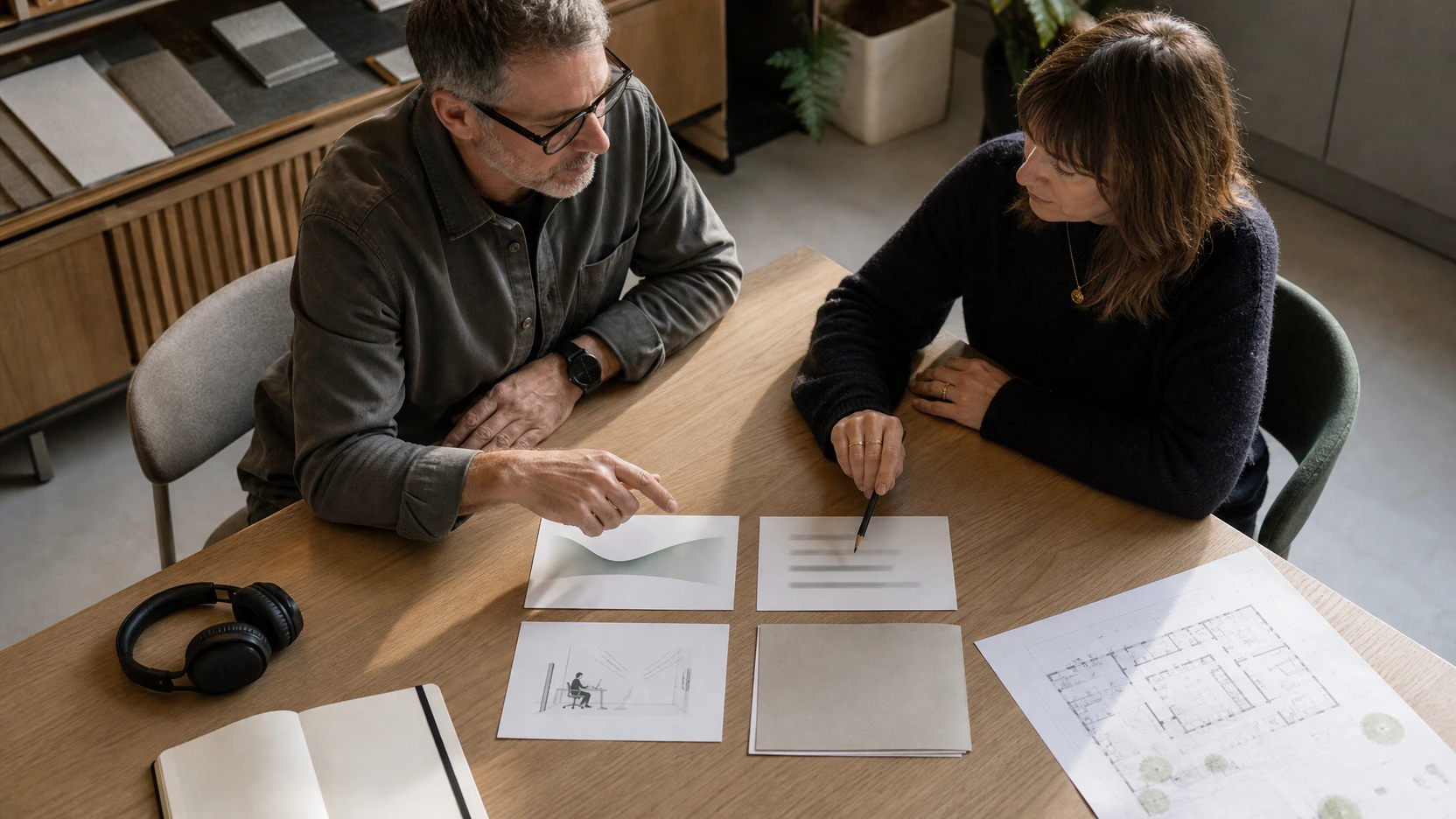
Four questions that should stay separate
- Is speech audible? A listener notices speech or voice-like sound.
- Is speech intelligible? A listener can understand words or meaning under defined conditions.
- Is speech distracting? Speech competes with the listener’s task, even if every word is not clear.
- Is the conversation adequately protected? The responsible owner accepts the residual risk for the named use case.
The fourth question cannot be answered by changing the label on the first three.
Map the listener positions that matter
Speech privacy has a direction and a location. Mark both on the floor plan.
For an office pod, the most common path is inside to outside: an occupant speaks and a person at a nearby desk, route, or shared setting may hear the conversation. Outside-to-inside sound matters too, but that is a different user-comfort question. A single “acoustic performance” line can hide the difference.
Create a listener map around the proposed position:
- place the exact pod footprint and door orientation;
- mark fixed workstations and scheduled work settings;
- add circulation, waiting, reception, print, refreshment, and informal pause points;
- identify people who could remain near the pod for longer than a passer-by;
- note reflective surfaces, open connections, corners, screens, and large absorptive areas;
- label the listener positions that require review and the owner of each decision.
Do not test only where the result is easiest. Include the closest credible listener, the normal seated ear position, and any route where a person could pause.
The office pod sizes guide supports the separate footprint and capacity review. Keep dimensions and acoustic acceptance in linked records rather than letting one stand in for the other.
Use product test data for its proper job
The ISO 23351-1:2020 page describes a laboratory method for comparing complete furniture ensembles and enclosures. It measures sound power with the product absent and with a speech-like source inside the product, then reports speech-level reduction.
That is valuable product evidence. It answers how the tested enclosure reduced radiated speech level under the stated laboratory method and configuration.
It does not directly answer whether words are intelligible at a named desk in the project.
The newer ISO 23351-2:2026 field-method page covers apparent speech-level reduction of furniture ensembles and enclosures in field conditions at engineering-grade accuracy. Its official preview still separates that product property from insertion loss to a specific receiving position in a room.
Use both boundaries:
- product-level evidence supports enclosure comparison and model review;
- listener-position evidence supports the project privacy decision;
- neither is permission to promise confidentiality without the responsible specialist and acceptance record.
For current MOVUSH selection, treat model-specific acoustic performance as pending until the applicable report and exact configuration mapping are approved. The public MOVUSH acoustic pods overview introduces the product category, while controlled files carry technical evidence.
Add the room and operating context
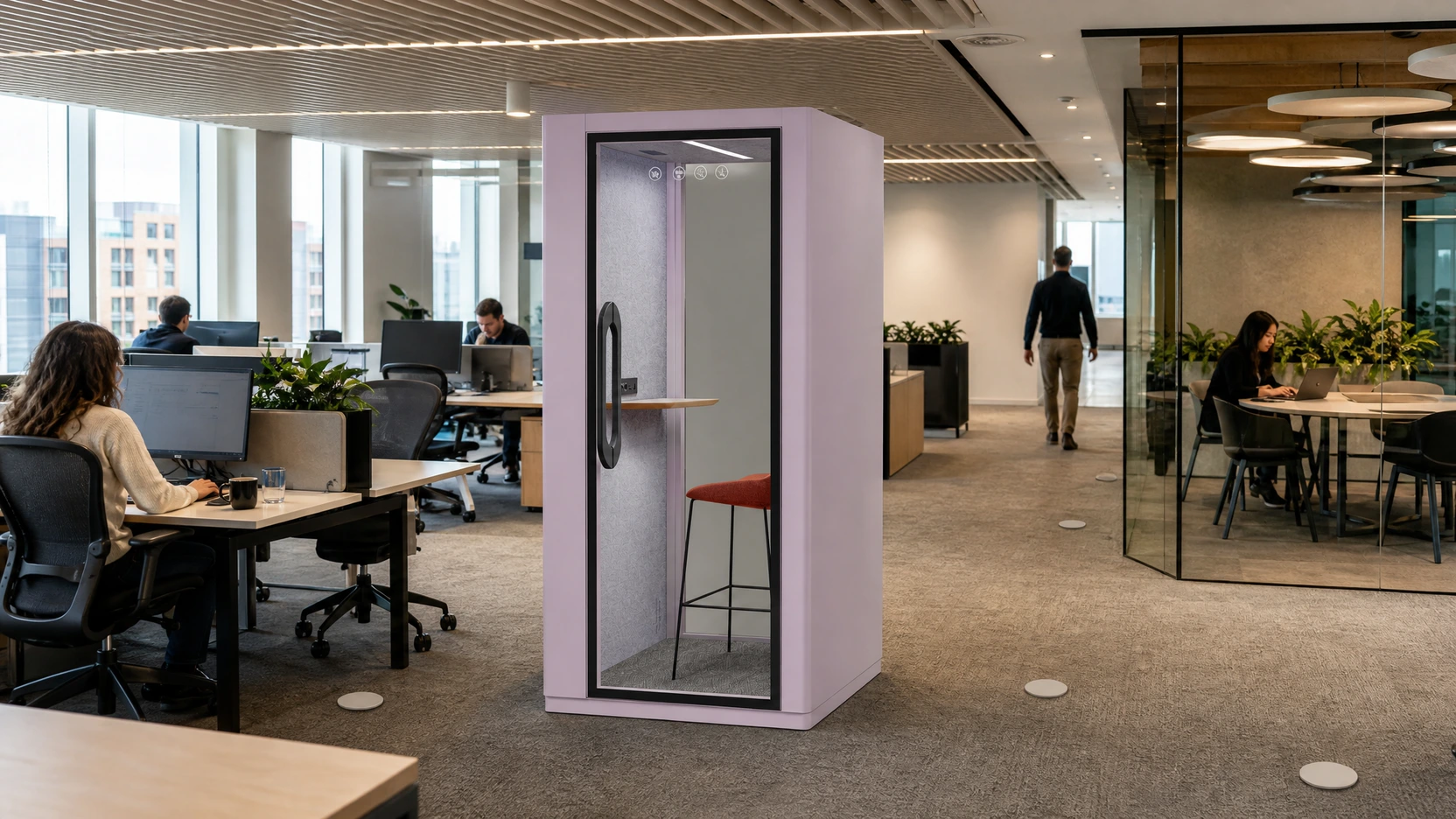
The pod does not operate in an acoustic vacuum. Its relationship with the host room changes what a listener experiences.
The ISO 3382-3:2022 page describes room-acoustic measurements for unoccupied open-plan offices, including spatial decay of speech, background noise, STI-related evaluation, comfort distance, and distraction distance. This is room evidence, not a replacement label for the enclosure.
Record the conditions that could change the decision:
- distance and orientation between talker, pod, and listener;
- background sound from people, ventilation, equipment, and building services;
- absorption and reflection from ceilings, walls, floors, glazing, furniture, and screens;
- open connections to quiet rooms or concentration settings;
- pod door closure and seal condition;
- pod ventilation, power, and installed operating state;
- speech level, number of speakers, speakerphone use, and meeting equipment;
- time of day and expected occupancy pattern.
The US General Services Administration’s Sound Matters guide also treats speech privacy as a layered problem involving isolation, background sound, absorption, room acoustics, and planning. Its example values belong to their stated context. Do not copy them into a MOVUSH specification as universal targets.
Choose an evidence route by risk
Not every call requires the same review. The evidence route should rise with the consequence of overhearing.
Routine workplace calls
Start with a controlled enclosure report for the exact model and configuration. Add a representative placement review and a witnessed pilot during realistic surrounding activity.
Record exceptions. A result that is acceptable beside an active collaboration area may not suit a quiet library-like zone.
Personal or employment conversations
Define who should not understand the conversation and where those people may be. Ask HR, workplace, facilities, and the acoustic reviewer to agree on the test condition and acceptance record.
Do not rely on a casual walk-by if the consequence is material.
Legal, clinical, regulated, or security-sensitive conversations
Escalate before selection. The responsible legal, security, clinical, compliance, or acoustic specialist must define the requirement and determine whether a furniture enclosure is an appropriate control.
An office pod may be one layer in a wider plan. It is not automatically a secure room, and this article does not establish regulatory compliance.
Run a witnessed site check
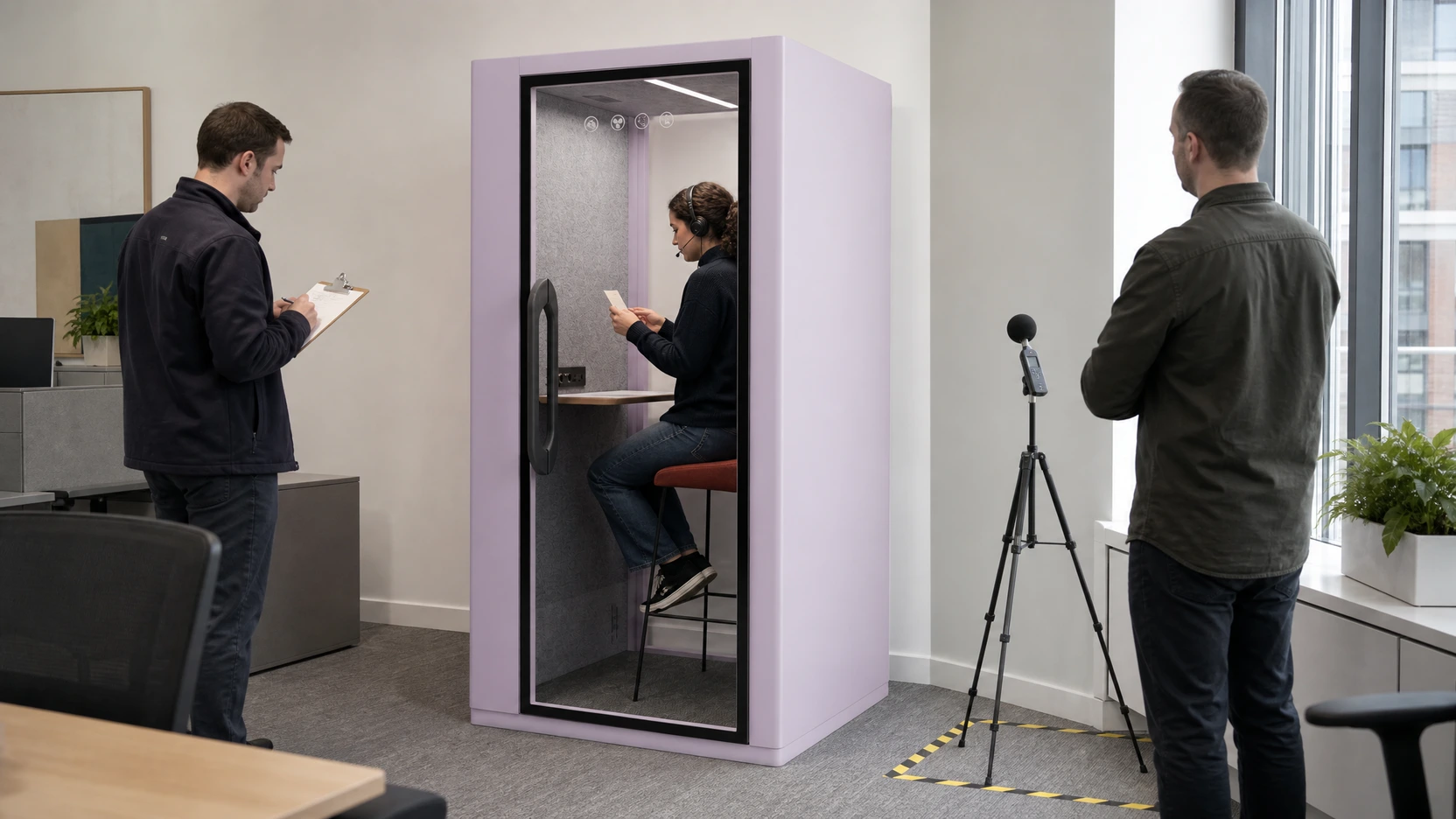
A site check should be repeatable enough that another reviewer can understand what happened. “We tried it and it seemed quiet” is not a controlled record.
Prepare the check before the pod arrives:
- lock the model, configuration, position, door orientation, and operating state;
- define the talker script or specialist test signal without using confidential content;
- mark the protected listener positions and normal listening posture;
- record surrounding occupancy, equipment, background condition, finishes, and unusual noise;
- identify who speaks, who observes, who measures, and who approves;
- run the agreed scenarios with door and ventilation conditions documented;
- preserve observations, instrument details when used, deviations, photographs where permitted, and unresolved items;
- repeat any condition that changed materially before sign-off.
Use natural speech only for a representative user review. If the project needs a quantified intelligibility result, have the acoustic specialist select and control the applicable method.
Write the privacy acceptance record
The acceptance record should show why the decision was made, not just whether the pod “passed.”
| Record field | Required entry |
|---|---|
| Use case | Conversation type and consequence |
| Product | Exact model, size, configuration, revision, and quoted condition |
| Product evidence | Method, report control, test boundary, result status, limits, and model mapping |
| Listener map | Named positions, distance, orientation, and people represented |
| Room condition | Layout, finishes, background condition, occupancy, and building-services state |
| Operating condition | Door, ventilation, equipment, speech behavior, and duration |
| Acceptance method | Document review, representative pilot, specialist measurement, or combined route |
| Decision | Accepted for named use, accepted with conditions, rejected, or pending |
| Ownership | Reviewer, approver, date, exceptions, and re-test trigger |
Keep “accepted for named use” narrower than “private.” A pod approved for routine calls near an active team area has not automatically been approved for employment, legal, clinical, or security-sensitive conversations.
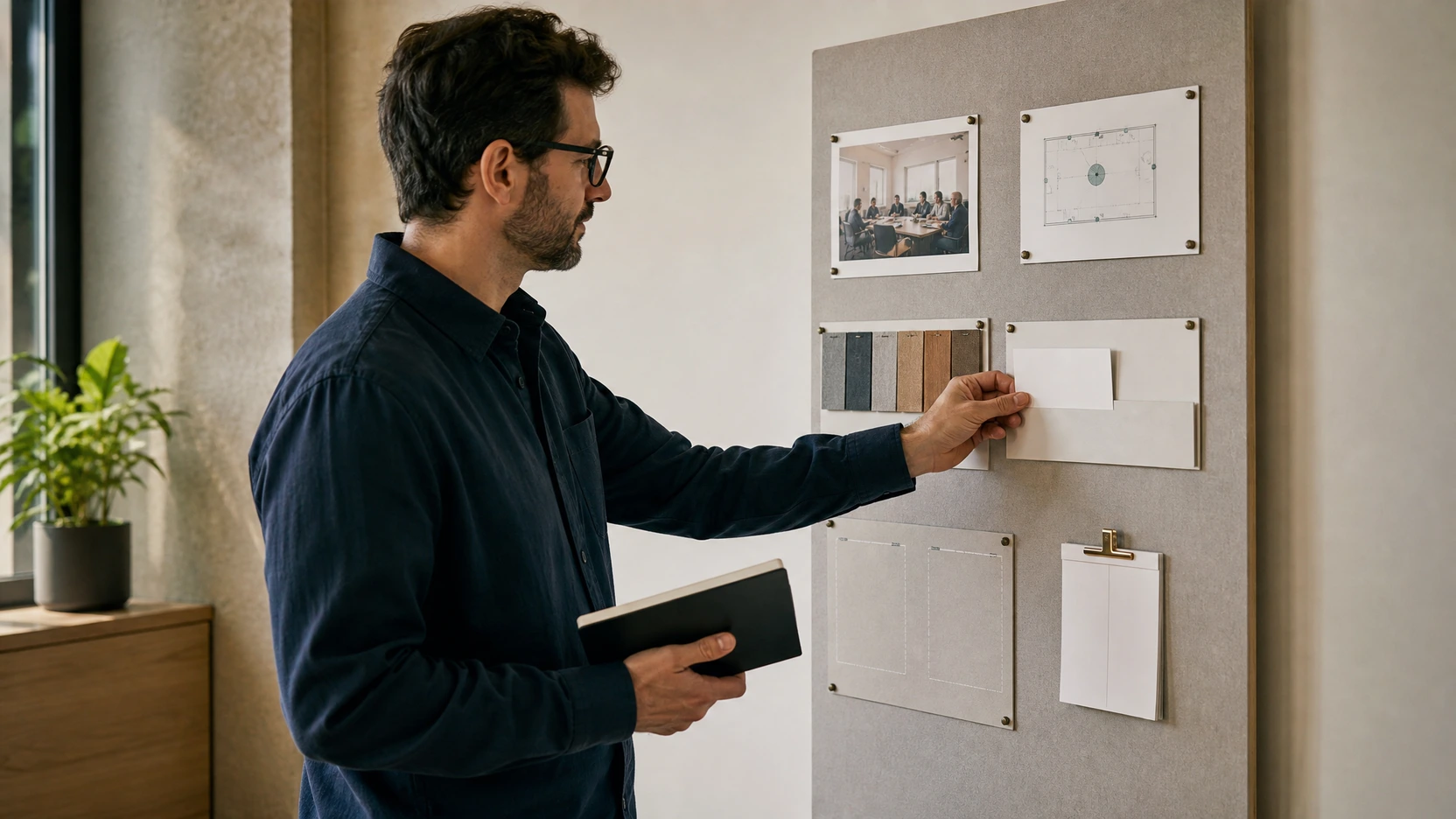
The MOVUSH specification resources can support controlled product-file requests. The project record must still identify which files apply to the exact model and condition.
Treat high-risk conversations separately
Product selection should not carry a risk the project has not defined.
For higher-risk conversations, ask five questions before procurement:
- What information is being protected?
- Who is the credible listener or threat?
- Which positions, times, and operating conditions are in scope?
- Which professional, policy, legal, or regulatory requirement governs acceptance?
- What happens if the pod and room cannot meet that requirement?
Possible answers may include a different location, greater separation, a purpose-built room, scheduling controls, a sound-masking or room-acoustic strategy designed by specialists, operating rules, or a combination of measures. Do not assume a product-only answer.
This is where the office pod selection guide becomes useful again. It helps the team compare capacity, activity, site conditions, and evidence without treating acoustics as the only project variable.
Turn the requirement into a pod brief
Speech privacy starts with an information-risk decision and ends with a controlled acceptance record. Between those points, keep product speech-level reduction, listener-position intelligibility, host-room acoustics, and project approval as connected but separate evidence layers.
Do not ask one dB number to do all four jobs. Define the conversation type. Map the listeners. Review the exact enclosure evidence. Record the room and operating state. Then let the responsible reviewer choose and witness the acceptance route.
Share the intended conversation types, listener map, surrounding room conditions, and responsible reviewer with MOVUSH. The team can use that brief to identify candidate pod configurations and the controlled files that still require confirmation before selection.