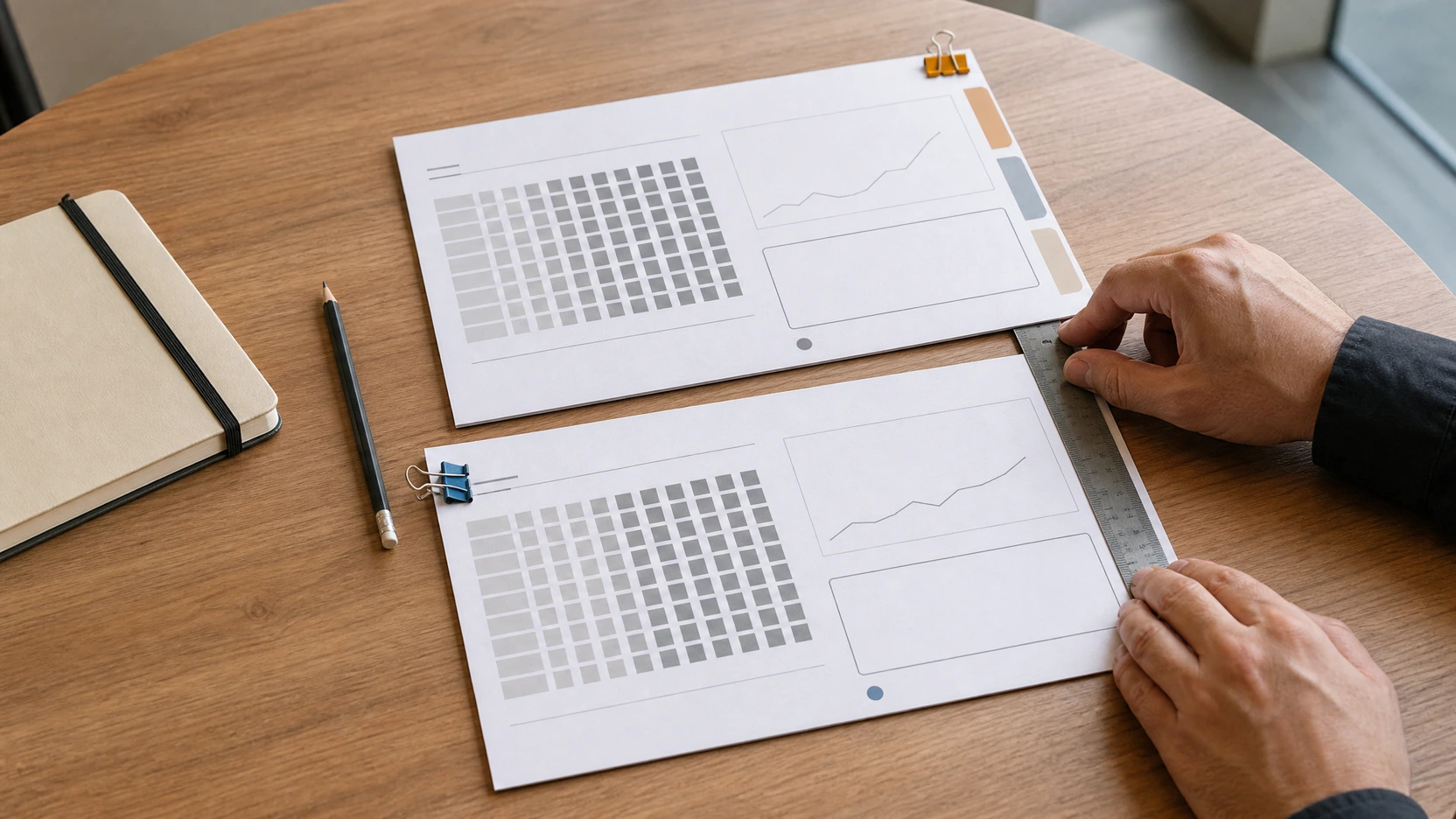
An office pod acoustic test report is comparable with another report only when both documents answer the same technical question. A matching dB unit is not enough. The method, edition, test object, configuration, operating state, room, calculation route, reporting limits, and document status must align closely enough for the intended decision.
Start with the full reports, not two product-page numbers. Build a row-by-row comparison, mark every difference, and ask the responsible acoustic reviewer whether those differences change the conclusion. If a field is absent, record it as unknown. Do not repair the gap with a supplier assumption.
This guide gives specifiers and technical buyers a defensible way to label two reports comparable, conditionally comparable, not comparable, or pending evidence before a pod enters a specification.

Ask whether the reports answer the same question
The first comparison is about scope, not performance.
A report for a complete enclosure can describe how that test object reduces radiated speech level under a named method. A building-element report may rate a wall, door, window, floor, or partition. An absorption report concerns sound absorbed by a material or assembly. A workplace measurement may address a product in field conditions or a listener position in a specific room.
Those documents can all use decibels. They do not necessarily measure the same quantity.
Write one sentence for each report:
> This document measures [quantity] for [test object] under [method and conditions] so that [decision] can be made.
If the two sentences name different quantities or decisions, stop the numerical comparison. The documents may both be useful, but one cannot substitute for the other.
Lock document control before reading the headline
Identify the controlled document you actually received. A screenshot, sales slide, certificate image, test summary, and complete signed report have different evidential weight.
Record these fields before copying a result into a tender table:
| Document field | What to capture | Why it matters |
|---|---|---|
| Issuer | Legal name and issuing location | Distinguishes the report owner from a reseller or marketing author |
| Report control | Number, date, revision, page count, and language | Prevents mixed pages or an obsolete revision from being treated as current |
| Approval | Signatory, approval block, or stated electronic validation route | Shows how the document was released |
| Test period | Receipt and test dates where given | Places the evidence against the product revision |
| Completeness | Appendices, photographs, tables, deviations, and referenced files | Reveals whether the number has lost its conditions |
| Use restriction | Public, client-only, internal reference, research, or another limit | Controls how the evidence may be shared and quoted |
Do not treat a polished cover as proof of scope. Conversely, plain formatting does not invalidate a controlled report. The decision comes from document identity, contents, and applicable review.
Match the method, part, and edition
The method tells you what was measured and how the result was produced. Record the complete reference, including year and part number.
The ISO 23351-1:2020 official page describes a laboratory method for comparing complete furniture ensembles and enclosures. It measures sound power with the product absent and with a speech-like source inside the product, then derives frequency-dependent level reduction and an A-weighted speech-level-reduction quantity.
The ISO 23351-2:2026 official page covers apparent speech-level reduction for furniture ensembles and enclosures in field conditions at engineering-grade accuracy. Laboratory and field routes are related, but the report must identify which route was used and how its requirements were met.
Do not replace either route with a building-element rating. The ISO 717-1:2020 official page defines single-number ratings for airborne sound insulation in buildings and building elements such as walls, floors, doors, and windows. Its scope and source measurements differ from a complete-enclosure speech-level-reduction method.

When editions differ
An older and newer edition may use related concepts yet differ in required conditions, reporting, or precision. Do not assume the change is immaterial.
Ask the reviewer to identify:
- clauses that affect the test setup or calculation;
- changed equipment, correction, or reporting requirements;
- transition rules relevant to the project market;
- whether the reports can be normalized without reconstructing missing data.
If that review is unavailable, keep the comparison pending.
Match the exact test object
Method alignment does not prove product alignment. Two reports can use the same standard and still describe different objects.
Capture the complete sample identity:
- public model name and the controlled internal reference where permitted;
- size, capacity, revision, serial or sample identifier;
- wall, ceiling, floor, glazing, door, seals, and panel build-up;
- ventilation, lighting, power, furniture, and fitted equipment;
- factory options, prototype parts, deviations, and post-test changes;
- photographs that show the specimen actually tested.
Product-family language is too broad for a report comparison. A result for one size or revision does not automatically transfer to another member of the range.
For current MOVUSH selection, use the acoustic pod product overview only to identify the category and public model route. Request controlled model-specific evidence separately. Do not map a legacy specimen to a current sale configuration without written product-owner confirmation.
Compare setup and operating condition
The same enclosure can produce evidence that is difficult to compare when the setup changes. Read the method section, photographs, deviations, and result notes together.
For each report, record:
| Setup field | Comparison question |
|---|---|
| Test environment | Laboratory, field room, or project location; which method requirements applied? |
| Product position | Where was the object placed and oriented relative to room boundaries? |
| Source | What signal and source device were used, and where were they positioned? |
| Receivers | What microphone arrangement, distance, height, and averaging route were used? |
| Background | What correction or acceptance rule addressed background noise? |
| Environment | What temperature, humidity, room condition, or other stated limit applied? |
| Door and openings | Closed, open, latched, sealed, or otherwise controlled? |
| Services | Was ventilation running, off, altered, or not recorded? |
| Deviations | Which departures from the method were approved or left unexplained? |
An absent field is not automatically a failure. It is a comparison risk that must be resolved by the report owner or reviewer.
Read the result table, not one dB number
Check the name, symbol, unit, frequency range, weighting, calculation, and classification route for every reported quantity.
For a speech-level-reduction report, preserve the frequency-dependent data alongside the single-number result. The band data can reveal differences hidden by similar headline values. It also helps a reviewer detect transcription errors or a result copied from another method.
Do not average two single-number ratings, convert them into a percentage, or subtract one from another unless the governing method and reviewer explicitly support that operation. A numerical gap is not a universal statement about audibility, intelligibility, confidentiality, or installed workplace performance.
Classification needs its own row
If a report assigns a class, record the classification table, standard, edition, thresholds, and whether the class was calculated by the issuer. A class label detached from its method can look more comparable than it is.
If one report gives a quantity but no class, do not assign one from memory. Ask the competent reviewer to confirm whether classification is allowed for that document and edition.
Check competence, uncertainty, and subcontracting
Issuer identity and laboratory competence are related but separate questions. Record what the report actually states about the testing location, accreditation, scope, calibration, uncertainty, and subcontracted work.
The ISO/IEC 17025:2017 official page describes requirements for the competence, impartiality, and consistent operation of testing and calibration laboratories. Accreditation bodies use it as assessment criteria. That does not authorize you to claim a laboratory or a particular test is accredited when the report does not establish it.
Ask for evidence that connects any accreditation claim to:
- the named laboratory and location;
- the relevant method and measurement scope;
- the period when the test was performed;
- any subcontracted activity;
- the report or result being compared.
Measurement uncertainty may also affect whether a small numerical difference is meaningful. Preserve the report’s stated uncertainty and decision rule. If either is missing, ask the acoustic reviewer how the comparison should be qualified.
Preserve limitations and use permissions
The final pages often contain the boundary that a sales summary omits.
Look for sample-only wording, client-supplied information, reproduction rules, internal-reference limits, signature notes, subcontractor statements, exclusions, and conditions for using the issuer’s name or mark. Record these exactly in the project evidence index.
A technically relevant report may still be unsuitable for public quotation. That does not make it useless. It means the team should use it inside its permitted scope and request a public or tender-suitable document where needed.
The MOVUSH resource library provides the route for requesting current project information. Keep the received file, its permission status, and the product-mapping decision together.
Build one row-by-row comparison worksheet
Use a single matrix rather than two separate summaries. Separate what the documents state from what the project team concludes.
| Comparison row | Report A | Report B | Alignment | Owner and next action |
|---|---|---|---|---|
| Quantity and decision | Exact metric and intended use | Exact metric and intended use | Match, differ, or unknown | Acoustic reviewer |
| Method control | Standard, part, edition, route | Standard, part, edition, route | Match, reviewed difference, or unknown | Acoustic reviewer or issuer |
| Document control | Issuer, number, date, revision, pages | Issuer, number, date, revision, pages | Complete or incomplete | Technical buyer |
| Test object | Model, size, revision, components | Model, size, revision, components | Same, mapped with deviations, or different | Product owner |
| Operating state | Door, ventilation, openings, equipment | Door, ventilation, openings, equipment | Match, material difference, or unknown | Product owner and reviewer |
| Setup | Room, placement, source, receivers, corrections | Room, placement, source, receivers, corrections | Method-compliant alignment or difference | Acoustic reviewer |
| Result | Bands, single number, class, uncertainty | Bands, single number, class, uncertainty | Comparable, qualified, or not comparable | Acoustic reviewer |
| Restrictions | Use, reproduction, sample, subcontracting | Use, reproduction, sample, subcontracting | Compatible or restrictive | Report owner and procurement |
The worksheet is the evidence record. It should show N/A or unknown openly rather than hiding empty cells in narrative text.
Use four decision labels
End the review with one of four labels and a reason:
- Comparable: the reports address the same quantity and decision, with sufficiently aligned method, test object, setup, calculation, and document status.
- Conditionally comparable: named differences exist, but the responsible reviewer has defined how the comparison may be used and what it cannot support.
- Not comparable: the documents measure different quantities, objects, or conditions, or a material difference prevents a valid numerical comparison.
- Pending evidence: a required report field, product mapping, permission, uncertainty statement, or expert review is missing.
Avoid ranking products when the evidence is pending. Procurement can preserve both candidates while the missing row is resolved.
Hand off a defensible specification record
The conclusion belongs in the project file, not just a meeting note. Keep the two complete reports, comparison worksheet, product configuration mapping, reviewer comments, permission status, decision label, owner, date, and re-review trigger together.
Use the MOVUSH specification resources to request model-specific files, then use the office pod selection guide to coordinate acoustics with activity, capacity, site conditions, services, and commercial scope.
An office pod acoustic test becomes useful when its boundary survives the comparison. Start with the method. Match the specimen and operating state. Read the full result table and limitations. Then let the named reviewer decide whether the evidence is comparable for the exact specification decision.
Share both complete reports, the proposed model and configuration, the destination market, and your comparison worksheet with MOVUSH. The team can confirm product-specific fields and identify what still requires the report owner or acoustic reviewer.