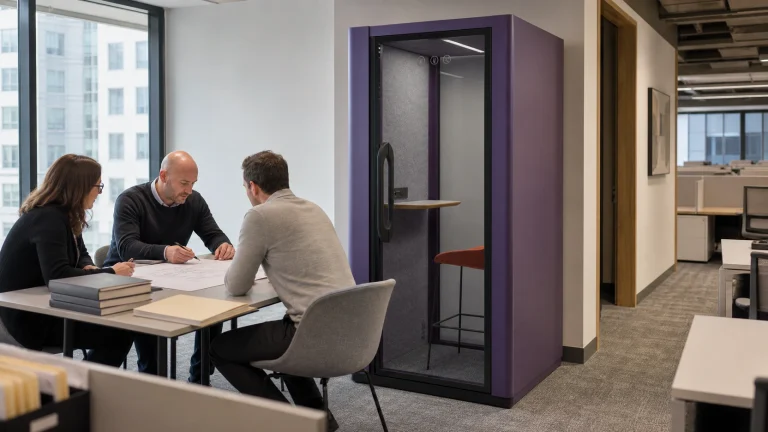
An office pod is most useful when it answers a specific gap in the workplace. That might be a quiet place for video calls, a setting for confidential conversations, or an extra room for a small team when the meeting rooms are already booked.
The product itself matters, but the better starting point is the activity. A pod that works well for a 20-minute call may not suit a two-person interview, and a larger meeting pod needs more than extra seats to become a comfortable place to work. Use the following steps to narrow the brief before comparing models.
1. Start with the activity, not the product name
Write down what is actually missing from the floor plan. “More privacy” is a useful observation, but it is not yet a brief. Is the problem phone calls carrying across an open office? Is it a shortage of one-to-one spaces? Are hybrid meetings spilling into circulation areas?
Give each activity a simple label: individual call, focused work, one-to-one conversation, interview, small meeting or team session. It keeps the selection grounded in how people will use the space rather than how a product looks in a rendering.
2. Match capacity to the real group size
Most pod ranges include formats for individual work, two-person conversations and group meetings. MOVUSH’s current collection is presented in the same practical way: focus pods for individual calls and work, two-person pods for private collaboration, and larger settings for meetings.
Choose for the number of people who will use the pod most often, not the largest meeting that happens once a month. A two-person pod can be a more valuable shared resource than an oversized meeting space if it is used consistently throughout the day. Conversely, if a team regularly joins video meetings together, confirm whether the table, seating, sightlines and screen position will genuinely support that use.
3. Plan the footprint and the route into the room
Treat the pod as part of the floor plan, not as a loose item of furniture. Confirm the external dimensions, door swing, circulation around the pod, ceiling height, delivery access and the location of power before the order is finalized.
For example, the 2026 MOVUSH pod material includes compact single-user formats as well as two-, four-, six- and eight-person configurations. Those options are a useful starting point, but only the current technical sheet for the selected model should determine the project drawing. Dimensions, wheel arrangements, internal furniture and door orientation can change the space you need to reserve.
4. Ask how the interior will support the task
A pod is not only an enclosure. Inside it, people need appropriate light, air, a usable work surface and enough room to sit or meet without feeling rushed. Check the standard scope and the options separately. Ask what is included for lighting, ventilation, power, table surfaces, seating, monitor support and controls. If the project requires a specific plug, screen, finish or brand application, put it in the written brief rather than assuming it is standard.
5. Compare privacy with evidence, not adjectives
Avoid choosing a pod based on the word “soundproof.” No office pod should be treated as completely soundproof. The result depends on the model, construction, tested configuration, ventilation state, installation and the acoustic conditions around it.
Instead, request the complete acoustic documentation for the exact model under consideration. Check the test method, laboratory, date, configuration and reported metric. This makes it much easier to compare alternatives fairly and much safer to explain the expected outcome to users and stakeholders.
6. Think about the space around the pod
The pod works best as part of a wider workplace mix. Pair private settings with comfortable task seating, nearby touchdown space and clear behavior expectations. A single phone pod can relieve pressure on an active neighborhood; a group pod can turn an underused zone into a working meeting setting. Neither should become the only place where people can find quiet.
A useful next step
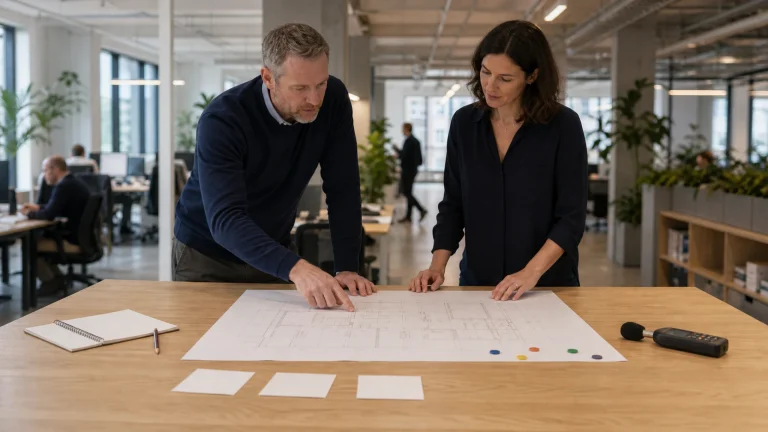
Before comparing finishes, review a marked-up floor plan with the people responsible for design, facilities, IT and installation. Include the activity, capacity, likely duration of use, power location and access constraints for each proposed pod. That one conversation turns a general interest in privacy into a project-ready shortlist.